Warforged (Race)
Vast numbers of Warforged were created aeons ago, in the catacylsmic War of the Pious and Philosophers. As the war ended, many thousands were laid down in Stasis Vaults to await the next war - but the world turns, and that war never came... Now, thousands of years later the stasis-seals are failing, returning these ancient steel warriors to the light of a new age...
http://www.wizards.com/dnd/files/dragon/364/364_Warforged.pdf
Warforged Paladin-1: http://www.wizards.com/dnd/files/dragon/364/364_WarforgedPaladin.pdf
Epic Destinies
The Elf High Mage and Mythic Sovereign Destinies are suitable for Wilderlands PCs:
http://www.wizards.com/dnd/files/dragon/367/367_Epic_Faerun.pdf
Monday, 30 May 2011


Sunday, 3 April 2011
Non-Human Sub-Races
Non-Human Sub-Race Backgrounds
DWARVES
CITY DWARVES
The Kazadrach, or City Dwarves, are the most commonly
encountered dwarves in the cities and towns. Most city
dwarves are smiths, jewelers, merchants, or alchemists. City
dwarf men trim their beards short and neat, or simply wear
large, flowing moustaches. Women do not grow facial hair.
City dwarves can also be found in the southern city of Chim.
Description: Tan skin, red, brown or blonde hair, blue or
green eyes, 4 ft. 0 in., 160 lbs, portly build, typically Unaligned.
• Background skill: Bluff.
DEEP DWARVES
The Kazadrugar, or Deep Dwarves, shun daylight and
prefer to live out their lives underground. They are an
unhealthy race, and spend most of their time studying dark
magic, seeking ways to conquer and enslave their cousins
and neighbors. They keep goblin and troll slaves to do most
of their labor, leaving them more time to study. Deep dwarf
males have a difficult enough time growing any hair let
alone beards. Their women (the few there are) are typically
bald, or possess but a few wispy strands of hair on their heads.
Deep dwarves rarely wear armor, as it interferes with their
magic, and are usually only armed with a dagger (often
poisoned). Deep dwarves do not revere the gods, instead
worshiping demon lords and gods of evil knowledge.
Description: Splotchy gray skin, bone white hair, pink
eyes, 3 ft. 8 in., 120 lbs, lumpy build, typically Chaotic Evil..
Background Skill: Arcana
Languages: Dwarven and Abyssal
HILL DWARVES
The Kazadurul, or Hill Dwarves, are a coarse, insular
warrior race. The clan thane is the highest social class of the
Kazadurul, as the clan folk believe the only true Dwarf King
is Kazadarum. Clan warriors often work together in mercenary
troops, fighting for one or more of the human lords,
though they will never fight another dwarf troop in such a
manner. Kazadurul females are equal to males, as the birth
rates are more equal among the hill clans; some even become
warriors. Kazadurul are as likely to work with wood as stone
and metal, and most of their villages are above ground, with
buildings of stone and wood. Hill dwarf men grow beards, but
not as ostentatious as the mountain dwarves. Women do not
grow beards, but often grow moustaches and sideburns. Hill
dwarves are typically armed with greataxes and armored in
chain shirt or splint mail. Hill dwarves worship Kazadarum
with zealous exclusivity, and consider mountain and city
dwarves to be heretical for their polytheism.
Description: Bronze skin, brown hair, green eyes, 4 ft. 2
in., 170 lbs, stocky build, typically Unaligned.
MOUNTAIN DWARVES
The Kazadaran, or Mountain Dwarves, are the most ordered
and hide-bound of a very stubborn race. Though perhaps best
known to reside in Thunderhold, Mountain Dwarves have
resided in many underground kingdoms, including the famed
dwarf kingdom north of Tarsh. Their society emphasizes honor
and obedience to social superiors. They pay very close attention
to ritual and precedence; every mountain dwarf has his
own position in the social order, and knows exactly where he
stands in respect to everyone else. Mountain dwarf women are
rare (only 1 in 10 are female), and so are kept secreted from the
rest of the world, as they are considered the most precious of
treasures. Mountain dwarf men are very proud of their beards,
and let them grow throughout their entire lives, braiding them
and decorating them with gems and jewels. Women grow
beards just like their men, though they are not as vain about
them as their men folk. Mountain dwarves are typically armed
with warhammers and armored in breastplate or half-plate,
while nobles wear full plate or even mithral plate. Mountain
dwarves revere Kazadarum, but also worship Goibhnie the
Divine Smith, Rosmerta the Bountiful, and Odin the All-
Father.
Description: Tan or ruddy pink skin, fiery red hair, blue
eyes, 4 ft. 5 in., 180 lbs, stocky build, typically Lawful Good.
FERAL DWARVES
The wild dwarves and carnivorous dwarves of the jungles
south of Chim are dwarves that have sunken to barbarism
and cannibalism. They do not speak more than in guttural
grunts and shouts and rarely are organized more than in
loose packs.
ELVES
There are nearly a dozen major known elven settlements
in the Roglaras, not counting the scores of small villages and
camps found in forest and glade. While each of the different
settlements has its own history and idiosyncrasies, most of
the elves living therein, regardless of the distance involved,
maintain a moderately unified culture. There are, however,
exceptions to this rule, and there are a number of strange
and unusual elven societies.
DARK ELVES (DROW)
The dark elves are so called due to nature of their
subterranean homeland and the hatred in their heart, not
the color of their skin. Though they are naturally very pale
skinned and haired, their flesh and locks are darkened and
singed by the fires of the earth and the smoke and cinders of
their great forges, where they endlessly craft weapons and
magic to use in their feud with the goodly races. They
sometimes cooperate with the deep dwarves and other
inimical races, though they never trust them fully.
Description: Soot-covered ivory white skin, singed bone
white hair, red eyes, 5 ft. 4 in., 100 lbs., lean build, typically
Chaotic Evil.
HIGH ELVES (ELADRIN)
Most of the elves of the northern portion of the
Wilderlands are of the high elven race, by far the most
common of the subraces of the elves. Most high elven folk
consider their settlements to form a single, widely dispersed
kingdom, known as Alfheim. Each lord of a settlement is
King in his own realm, answerable only to the High King,
though there has not been a unified High King for centuries.
The high elves are the greatest allies of the Dunael Woods-
Folk, forming a united front against the Orcs of the Purple
Claw in Dearthwood. A few high elves turn from the merry
ways of their brothers and strive to return to the ancient
ways of war and high wizardry; such folk become the stuff of
legends among humans and elves.
Description: Pale white to silver skin, black hair, blue
eyes, 5 ft. 8 in., 140 lbs, lean build, typically Good.
GRAY ELVES (GRAY ELADRIN)
The gray elves are the closest living embodiment of the
ancient elvish archetype, though even in their mighty eyes
can be seen the eventual passing of their race. Gray elves are
stately, contemplative, courtly, exacting beings, not taken
to merriment or quick action. They are very rare. The grays
that decide to take a hand in modern events make history
and forge legends. The most recent such was Vanuviel
Glamdring, who helped found the City State of the Invincible
Overlord and established one of the most important
dynasties in the region. His descendants founded Ashenshaft
and Palewood. There is a contingent of gray elves in Onhir
as well.
Description: Ivory white skin, gold or silver hair, violet
or amber eyes, 6 ft. 0 in., 160 lbs, lean build, typically Lawful
Good.
MER-ELVES
The mer-elves are the rare, distant kin of the merfolk. They
must live within the waters of river or sea or die of dehydration.
Mer-elves possess the tail of a great fish instead of legs,
though once per day they may magically transform and split
their tail into legs for up to an hour. They may be out of water
for no more than one hour per day. They are said to possess
magic that enables them to increase this time. They are most
commonly encountered on the Great River Roglaroon, where
they are the allies of the Roglo River-Folk.
Description: Pale green skin, greenish white hair, green
eyes, 6 ft. 0 in., 190 lbs, athletic build, typically Neutral.
Racial Traits: as per the PHB for Elf with the following
modifications or additions:
• Amphibious (Ex): Mer-elves can breathe both air and
water, although they rarely travel more than a few feet from
the water’s edge. They may spend one hour on land per day
without penalty but thereafter lose 1 healing surge for every
thirty minutes beyond the first hour they remain on land in a 24-hour period.
• Transform (Su): Once per day,for an hour, a mer-elf
may change his tail into a pair of human legs.
NORTHERN ELVES (ALVAR ELADRIN)
The northern elves, also known as Alvar, or Blue Elves,
arrived from the Great Glacier to the north. These northern
elves do not recognize close kinship with other elves,
considering all other elves to be cultural degenerates of the
original breed, save perhaps the gray elves, whom they
respect for their ancient ways but disdain for their peaceable
lifestyle. The Alvar claim but a single settlement in the
Roglaras for themselves, Seasteadholm on Goodholm Haven,
on the Warwik Peninsula.
Description: Pale blue skin, platinum hair, blue eyes, 6 ft.
0 in., 160 lbs, average build, typically Neutral.
SOUTHERN ELVES
The southern elves, also known as Altani Elves, or Red
Elves, are a barbaric race from Barbarian Altanis. Like the
human folk there they live in savagery, preferring the
atavistic ways of the barbarian to the civilized ways of their
ancestors.
Description: Pale red skin, tawny hair, red eyes, 5 ft. 0 in.,
100 lbs, lean build, typically Neutral.
WILD ELVES
Wild elves are the most reclusive of the elven folk, next
to the dark elves, though unlike their grim cousins, the wild
elves do not go out of their way to trouble other races. The
Green Elves, as they are also known, just want to be left
alone, even by other elves. Many tribes have forsaken
advanced technology and only use stone and wood. They
reside in the deepest forests and hidden valleys. A tribe of
wild elves is known to reside in the Darkling Woods, where
they seek refuge from the world at large, and maintain it by
slaying all who enter their domain, hanging the bodies from
the boughs of trees on the edge of the forest.
Description: Nut brown or green skin, green or tawny
brown hair, green eyes, 5 ft. 4 in., 100 lbs, lean build.
WOOD ELVES
Wood elves are the rustic cousins of the high elves,
paying lip service to the concept of Alfheim, and living
however they please otherwise. They prefer to live in forests
and wilderness, away from other races as much as possible,
though they are not as murderously xenophobic as their
wild elf cousins. Their main realms are the northern
Dearthwood (where they actually work with the Elves of
Alfheim in Dearthwood), though they may be found in
most fair forests and woods of the Wilderlands. They avoid
cities and towns, disdaining even the villages of more
civilized folk. They are at eternal odds with orcs, goblins,
and trolls, even moreso than their wild elven cousins.
Description: Tan white skin, blonde or coppery red hair,
green eyes, 5 ft. 4 in., 120 lbs, lean build, typically Neutral.
FERAL ELVES
Some very few elves in the depths of evil forests have
descended into barbarism, cannibalism and madness.
GNOMES
Gnomes are believed to be faeries that have somehow lost
their ties to the land, though they are still very earthy, and
love the forests and hills. Some sages claim that the gnomish
race is descended from a magical cross between faeries and
dwarves, though all three races deny this vehemently.
Gnomes are actually fairly rare, there being only the single
major settlement of them in the east, in the village of
Lightelf. Other gnomes are encountered uncommonly in
the cities and towns, the deep forests, and haunted hills.
Unlike other many other races, there are no relevant
subdivisions of gnomes. Their racial characteristics and
general description are uniform across the Wilderlands.
There are several cultural differences worth noting:
City Gnomes: City gnomes have been found in the cities of
man since time immemorial. They are a sorcerous race, steeped
in the ways of illusion and phantasms. They also are highly
respected as alchemists and herbalists, and, perhaps, second
only to the dwarves in renown as brewers of ale and beer. Some
are renowned tinkers, and no few city lords have a gnome sage,
teacher, or mechanic in their employ, to work on interesting
clockwork golems, clocks, and other unusual constructs.
Forest Gnomes: Forest gnomes are pudgy, roly-poly
recluses who live in deep forests, away from other creatures
save sylvan animals and faeries. They form fast friendships
with woodland animals. They live in burrows, tree-stumps,
and earth-covered homes, similar to halfling burrows, much
like brownies and leprechauns, who are their greatest allies.
They wear pointed hats in mixed company (usually brown
or green, never red-colored) and rarely leave the forests.
Like their city cousins these gnomes are renowned for their
herbalism and brewing skills. They are mistaken for simple
comical, whimsical, rustic creatures by other races, and as
such their powers are often underestimated.
Lightelf Gnomes: Lightelf gnomes are unlike their cousins
in that they have abandoned the ways of magic in favor of
martial studies. They are hunters, and trappers, farmers and
gatherers. They are an embittered people, stuck between the
human powers of the Skandiks and the City State, lorded
over by the former, corrupted by the latter. Their society is in
flux, and on the edge of extinction. Many Lightelf gnomes
have left their home to find a better living elsewhere. They
seek in most cases to serve their city cousins as guards and
mercenaries; most accept them, though they are wary of
them, for the Lightelf gnomes are a comparatively grim lot.
Forest gnomes dislike them, while the Red Caps hate them no
more or less than they hate everything.
Red Cap Gnomes: Red Cap gnomes are an insane breed of
gnome that lives in ruins and barren hills. Legends say that
they have been so since the Uttermost War, long ages ago.
Some legends say that their minds shattered during the great
battles of those days, or that their entire race was cursed, or
even that they fell into evil and degeneracy when they tried
to call upon powers too great for their minds. Regardless of
their origins, the Red Caps of today are a race of psychopaths,
seeking only to commit the most horrid atrocities they can
before they die. However, they are also, for the most part,
cowards, and remain in their haunted homes, far from other
peoples, festering in their own hate. Sometimes a slightly
sane Red Cap will leave the dread burrows and seek out a life
elsewhere. Dark lore indicates that the Red Cap gnomes are
the forerunners of the Kobold races.
HALF-ELVES
Half-elves are created as per the PHB. Except for halfmer-
elves, which are detailed below, half-elves do not
retain any of the abilities of their elvish parent other than
those outlined for standard half-elves in the PHB.
Half-mer-elves: Half-mer-elves are not as limited as
their elvish parents, having human legs. They are required
to immerse themselves in water for at least one hour a day.
They are able to breathe water as easily as air. They do have
slightly fishy characteristics, such as gill slits that appear
while they are immersed, sections of their body covered in
scales, and webbed feet and hands. Most encounters with
"mer-elves" are actually encounters with these half-breeds.
• Immersion: Half-mer-elves must completely immerse
themselves in water for 1 hour per day. They suffer 1 healing surge lost
for every four hours they fail to immerse themselves.
HALFLINGS
Like gnomes, the differences between halflings is mostly in
their appearance and culture and has little effect in game terms.
Halflings are created as per the PHB. The following details are
noted to provide background information.
Common Halflings: The most commonly encountered
halfling race is that of halflings of the cities and towns of the
Wilderlands. They concentrate on the skills and crafts they
consider most valued in the cities, the ones that they tend
to perform best, such as cooking, baking, tavern-keeping,
and other food service, as well as leatherworking, haberdashery,
tabac vending, and mercantile concerns. A fair
number of these folk also enjoy working in entertainment,
as well as more questionable practices, such as burglary and
more esoteric roguish schemes.
Highland Halflings: Highlands Halflings look not unlike
small versions of the local Altanians with slightly
redder skin and proportionally larger, hairier feet. They are
a Shire folk, and prefer to be left alone by the Altanians in
order to grow their pipeweed, tend to their small farms of
potatoes and maize, and husband their herds of small llamas.
They trade regularly with the Altanians, who find favor
with the Halfling's weed, their cheeses, vegetables, and
wood products. Highland Bounders (the guardians of the
boundaries of the Shire) typically wear leather armor and
carry short swords and slings. The few priests they have are
mostly druidic.
Stouts: Stouts obviously have some elements of dwarven
and probably gnomish blood, for they are very stout, and are
the only halflings of the region known to wear large, curly
beards under their great potato-shaped nose. Stouts are
known for their famous Blue Tabac, the most potent
pipeweed grown in the Wilderlands. The Bulwarkshire
Bounders are, however, a boisterous lot, more than happy to
crack open a head or two if that is what it takes for their land
to be left in peace. They wear chain shirts, hand axes, and
hand crossbows. They do not worship the gods in general,
figuring if they leave the gods alone, the gods will return the
favor. Some of the Bounders, however, revere Odin or
Mitra, for their martial and protective qualities.
Saturday, 2 April 2011
City, Clan & Area Notes
ALTANIAN BARBARIAN CLANS
Red Bear - west of Bisgen. The War Chief is rather weak, & hen-pecked by his Wise-Women. War-singer Haak. Shaman Uncia (PC).
Tigerclaw - south of Bisgen. War Chief Kalgol. Sword Knight Koltan of White Wolf Lodge was wounded in the Battle of the Shore. The chief Wise Woman, Mama Kala, is very powerful. Sword Knight Varek (PC) of Black Eagle Lodge.
Winged Ape - east of Bisgen. The new (4434 BCCC) War Chief is Prince Rameses of the Mountain Lion, married to Princess Lyssana, daughter of Hygaros (dec'd).
TOWNS
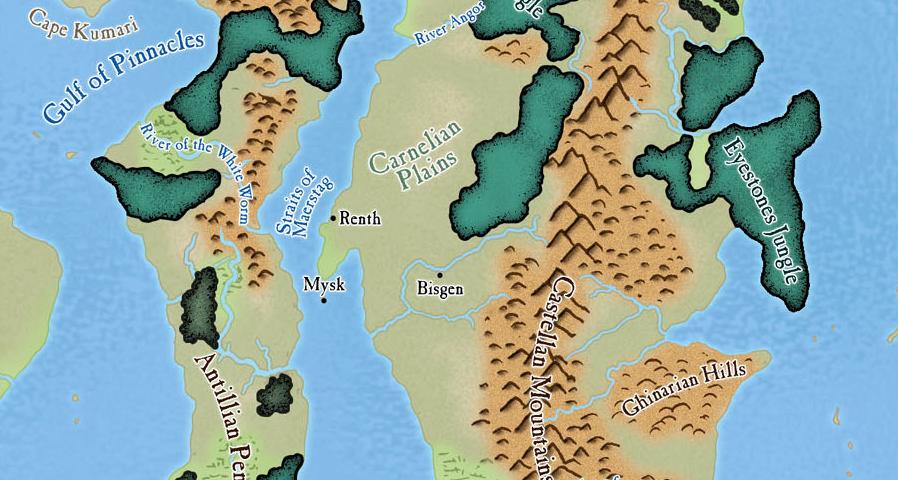
Bisgen (Altanis; Town, Pop. 2,248 within the walls; TL 4; 800gp limit):
Population: human 86% [mostly Altanian or Nerathi-Alryan,
a few Lagoldurman and other], half-elf 6%, elf 3%, halfling 3%,
other 2%); Resources: Horses.
Authority Figure: Parre, female Altanian. Important Characters: Eldrin,
half-elf wizard mistrusted by the populace; Nasan Tara, Altanian master of the herds.
Bisgen was established several thousand years ago by a wandering tribe
of Altanian nomads. Parre, the current ruler, is known as one of
the traitor barons in the court of the Overlord. She rules over a
prosperous small town made rich by continuing trade with the
elves at Renth. She sends troops to help Renth patrol the
Carnelian Plains and the areas to the south. Bisgen is noted for
the quality of its horses and merchants travel to the village to bid
on them. There is a small herd of elven steeds in the care of Nasan.
COLISTH (Village): (hex 1722) TL 1; 200
gp limit; Population 1,044 - half-elf (Southern) 37%, human 36% [mostly Antillian],
dwarf 10%, halfling 7%, other 10%; Resources: Silk.
Authority Figure: Prince Filor, male half-elf.
Important Characters:
Nalia, female elf (chief of the weavers);
Nolus, half-elf (captain of the village guards);
Regeck Eltas, male Antillian (master of the caravanserai);
Bakthet, male Antillian (slaver).
The area around Colisth is dotted with many stands of
mulberry trees. With the aid of humans from Bisgen, the
half-elves established a walled village to plant silkworm
colonies and harvest the silk, which are later woven into
the sails used for the ships built at Renth. Today Colisth is
a thriving trading post as caravans from around the
Wilderlands come to trade for the silk cloth produced at
Colisth. Visitors are encouraged to sleep securely at the
guarded caravanserai, because lately slavers have been
involved in kidnappings and disappearances.
Renth (Altanis; Town; Pop. 936 within the walls; TL 5):
Mixed (elf 70% [southern], half-elf 15%, human 8%,
dwarf 5%, halfling 3%, other 4%); Resources: Rope.
Ruler: Prince Cyn Light-foot, male elf [southern] Wizard.
Important Characters:
Cirawen, female elf [southern], master rope maker and rigger;
Sorelin, male half-elf captain of the local rangers.
The eastern shores of the Straits of Maerstag are lush
with hemp and flax. Ships made in the Great Forest,
Actun, Serpeant Little and other elven communities often
sail here with temporary sails and have their final rigging
done here. Cyn Light-foot is dedicated to the safety of
harvesters and often goes out on patrol with Sorelin and
the other rangers. Often times Plain Demons, as jackalweres
are known in the region, come out of the Carnelian Plains
and threaten the harvesters.
Mysk (Altanis; Town, Pop. 1,384 within the walls; TL 4):
Mysk is Antil's southernmost outpost and a trade market for goods
from Actun, Antil and the lands surrounding the Sea of Five Winds,
including Viridstan. Mysk was established 350 years ago after an
incident with foreigners at Antil caused the death of several
Windriders. The foreigners market for traders from the Sea of
Five Winds was moved to Mysk to prevent another such
incident.
Items of up to TL 8 are available here, despite the fact that the local craftsmen are not
very skilled.
Nert Iron-fist, the lord of Mysk, is noted for his nobility
and justice. He maintains law and order as well as the security of
the temple of Shang-Ta.
Sossul is the leader of the trade
delegation from Viridistan and looks upon the natives as inferiors.
He is also a priest of Armadad Bog and hasn't had much luck
in subverting the population to his views.
Achilleos is the leader of the Lightbringers of Mitra.
________________
LOCAL AREAS
Pazidan Peninsula (Altanis):
is the chief geographic feature of the northern
Wilderlands. Running from the Estuary of the
Roglaroon in the north to the fingers of Oricha in
the south, the Pazidan Peninsula was once home to
the legendary Orichalan Dragon Lords, who were
hunted into near extinction by the Altanians after
the fall of the Dragon Emperor. In many places, such
as the Carnelian Plains, the soil of the peninsula is
rich and red—like the color of the skin of the hardy
nomadic barbarians who wander the region in their
animal clans. The peninsula is criss-crossed with
many ancient roads, some built long ago by the Empire of
Kelnore, which have yet withstood the weathering of
the ages.
Lagoldurma Jungle (Altanis):
jungle covers Altanis from the area north
of the Carnelian plains up to the River
Greyrush, and from the coastline east to
the Ered Perack mountain range. Several
different tribes (many Altanian, some not)
live in the jungle, and at least three tribes
of headhunters reside here.
Carnelian Plains (Altanis):
Legends relate that this red earth plain was created by an army of skeletons
led by dark wizards against two huge armies
encamped here after celebrating a new alliance for
several days. Scholars discount the stories that this
once rich soil was stained red with blood. Farmers
here find many varieties of seed take well to the soil
but gardens must be walled to prevent Jackalwere
raids, known to the locals as plains demons. It is
home to several wandering tribes of Altanian barbarian
nomads.
Castellan Mountains (Altanis):
A gigantic sculpture of a sleeping Stone Giant sprawls along the
lower elevations of this mountain chain. Orcs have
taken residence in many ruined citadels and attempt
to coerce caravans into paying a toll to travel the
long pass called Bulwark’s Breach. Renowned for
water falls emptying into wetland valleys. Most have
never been explored due to the sheer cliffs. Natural
caves abound.
DISTANT LANDS
Irminsul Forest (Elphand Lands):
An uncharted and vast terrain, the Irminsul
holds many unknown secrets. It is the largest
contiguous woodland in all of the
Wilderlands. Thousands of square miles of
wooded land hold many mysteries and much
adventure. Elves, fey, dragons, humanoids, and
forest giants are all known to inhabit the
Irminsul, as well as saber-toothed tigers and
mastodons.
Wednesday, 30 March 2011
Tuesday, 29 March 2011
Background Notes: Climate, The Stone Axe Inn, Threats, Ancient Empires
Campaign Climate & Terrain
Players’ Map of the Wilderlands: http://necromancergames.com/judgesguild/misc/jg_pmap.jpg
The immediate area is humid and sub-tropical, resembling somewhat low-latitude South America. The equator runs north of the starting campaign area; in a line west to east through the Underwing Jungle, Grindwell, Gulf of Pinnacles, just north of the Eyestones Jungle, to just south of the Starlight River. The Carnelian Plains are a savanna; hot and wet in the rainy season, warm and arid in dry season. The land rises to the east; the Lagoldurna jungle rain forest is warm and humid year round, while the central mountain belt is sunny and temperate, cool on the high peaks.
Southern Hemisphere Savanna Climate – adapted from http://www.blueplanetbiomes.org/savanna_climate_page.htm
There is a distinct dry season, which is in the ‘winter’, the 6 months M5-M10. Savannas get all their rain in the ‘summer’ months (M11-M4). During the distinct dry season of a savanna, most of the plants shrivel up and die. Some rivers and streams dry up. Most of the animals migrate to find food. In the wet season all of the plants are lush and the rivers flow freely. The animals migrate back to graze. In the Carnelian Plains area the rainy season runs the 6 months M11-M4.
It is usually cooler during the dry season by a few degrees. Because it is in the tropical latitudes, that is still hot enough. The savanna climate has a temperature range of 68° to 86° F (20° - 30° C). In the winter/dry season, it is usually about 68° to 78° F (20° - 25° C). In the summer/wet season the temperature ranges from 78° to 86° F (25° - 30° C). In a Savanna the temperature does not change a lot. When it does, it is very gradual and not drastic. There is an annual precipitation of 20 to 30 inches of rain. In the 3 months M6-M8 hardly any rain falls at all.
More broadly, the Wilderlands is an Ice-Age world. The Great Glacier lies to the north of Valon, the frozen Ament Tundra with its mammoth-riding Amazons rises in the far south-west, and the equatorial rain forest cover is scattered and limited. The world is much drier than our own. There are no vast tropical rain forests as we presently see on Earth, just scattered patches. The fallen 'Demon Empires' in the far south, beyond Ghinor, are a howling frozen Chaos wasteland.
THE STONE AXE INN (Barbarian Altanis hex 2023)
Located at the intersection of the trade roads south to the horse-farming town of Bisgen, north-west to Colisth on the Blazing Stream, famous for its silks, and north-east to the highland Halfling township of Bisituni with its potatos and llamas, the Stone Axe Inn is a prosperous and thriving establishment. However recently the roads have been troubled by bandit raids from Shadar’s Den (hex 2022); Parre of Bisgen is offering 1,000gp for Shadar’s head. However his men are known to frequent the Inn, looking for likely targets, and spending freely of their ill-gotten gains. Shady fences frequent the Inn, looking to do business in these stolen goods, or carry ransom notes to relatives of those kidnapped. Open trade in slaves is conducted at Shadar’s Den itself, but sometimes recently enslaved captives are brought here by bandits in capture-hoods to avoid identification, and quietly sold to slavers round the back. The Inn is also a place where bands of adventurers gather to listen for rumours of adventure, mercenaries seek out employment, Altanian nomads come to carouse with the serving-girls, and assorted low-lifes try their luck.
The proprietor is Hagar Gudmunson, a grizzled and battle-scarred Skandik. Once a warrior huscarl of Ossary far to the north-east, he fled after killing one of King Alkazed’s henchmen in a drunken brawl. Years of adventuring across Altanis brought him quite a fortune, which he has invested in rebuilding and refurbishing what had once, long ago, been an ancient Nerathi imperial way-station, but had long been gutted and ruined, until it is now once again a favoured rest-stop of merchants and travellers. Rumours persist however that the dark and crumbling halls beneath the Inn, some dating back to the Turathi Empire of Glorious Doomfire, continue to hide sinister secrets...
Threats Further Afield
To the south beyond Bisgen, the Orc-ruled Wastelands are an expanding threat, as more and more Altanian villages fall beneath the cruel yoke of their inhuman masters.
Far to the north, beyond the Carnelian Plains and the Lagoldurna Jungle, is the Gate-Castle of the Black Sun, where it’s said the High Priest Morthor Coff schemes in the name of ancient Nerath to unleash alien abominations upon the world.

Sigil of The Black Sun
Ancient Empires of Altanis - Boundaries
Empire of Nerath (ca 3700-4197 BCCC): Founded by exiled Alryan nobles from the City State of the Invincible Overlord. Northern boundary at the River Greyrush & Lake of Temple Deeps, extending south over the Ghinarian hills and northern Arkhosia.
Bael Turathi ‘Empire of Glorious Doomfire’ (ca 1500-2500 BCCC)– founded by Ghinoran colonists who interbred with the indigenous Altani, eventually carving out a powerful sorcerous state from the decaying empire of Kelnore. Interbred with demons to create the Demonbrood/Tieflings. Battleplain Gwalion in the NW, Plain of Cairns and Sea Rune in the NE. South to the Ghinarian Hills and the dismal swamps SW of the Castellan Mountains. Destroyed in war with Arkhosia by the backlash from the Rain of Colourless Fire which annihilated Bael Turath, then by subsequent Altanian slave uprising.
Dragonborn Empire of Arkhosia (ca 1000-2500 BCCC) – Founded by the Dragonborn, a race created as slave warriors by the Orichalan Dragon Lords. From the southern borders of the Doomfire Empire, south across Oricha and Isle of the Blest, with outpost colonies in Ghinor beyond the southern sea. Capital Arkhosia in northern Isle of the Blest and other cities along the Straits of Oricha were destroyed by the Turathi Doomfire, eliminating Arkhosia in a single blow.
Empire of Kelnore (ca 500-1500 BCCC) – Founded by Northmen who copied and adapted Ghinoran culture. Extent as described in WoHF, across all Altanis and far to the NE.
Ghinoran Successor States - arose in the aftermath of the destruction of the Orichalan Dragon Lords. Ghninoran city-states spread across Ghinor, Oricha, and the Ghinarian Hills, with outposts far to the north and west.
Ghinoran Successor States - arose in the aftermath of the destruction of the Orichalan Dragon Lords. Ghninoran city-states spread across Ghinor, Oricha, and the Ghinarian Hills, with outposts far to the north and west.
Empire of the Orichalan Dragon Lords (?) – The only major power to survive the War of the Pious and Philosophers which destroyed the power of science across the Wilderlands. The Dragon Lords were humanoid entitities who bound the power of the mighty Dragon Kings to their will. At its height, the empire extended across all Pazidan, the Antillian Peninsula, and beyond, far into Ghinor to the south, and north across the Winedark Sea. Following a disastrous century-long war with the Demon Empires of the far south, Orichala was destroyed by a combined slave uprising of the Altani tribes under Bondorr (now god of swords), the Dragonborn slave warriors, and to the south the proto-Ghinorans under Prince Ghinor.
Altan Federation(?) - This almost unknown technological and peaceful culture predated the rise of the Dragon Lords, and was destroyed by them before and during the War of the Pious and the Philosophers. Originators of the Warforged. There are indications that the Altan in their desperation may have allied with the alien Markab.
Altan Federation(?) - This almost unknown technological and peaceful culture predated the rise of the Dragon Lords, and was destroyed by them before and during the War of the Pious and the Philosophers. Originators of the Warforged. There are indications that the Altan in their desperation may have allied with the alien Markab.
Saturday, 26 March 2011
Sword & Sorcery Tropes
SWORD & SORCERY TROPES
The Southlands campaign is intended to feel a bit like Conan the Barbarian if he were written by Fritz Leiber, with a dash of ER Burroughs (Tarzan, John Carter of Mars, et al), and even the Den & Taarna sequences from 'Heavy Metal'. Here's a fun list of compiled Swords & Sorcery tropes from rpgnet I think should fit Altanis well:
Originally Posted by Carl Stanford
The World
Decadent, Fading Empires
Remnants of a greater, ancient age.
Pyramids good; Ziggurats better.
Bands, tribes and hordes of nomads who are savage, greedy and a bane of all civilized travellers, but might be honourable and you might win their respect
Degenerate cannibal savage half-men who don't have any honour and probably worship something bad
Fat merchants in palanquins involved in slave,wine and art trade
'City of Thieves'
Steamy jungles
Inbreeding, usually but not always amongst the nobles, in a isolated locale, generally a jungle city, cavern complex, or wind swept plateau.
Lost city of the ______ people!
Domes and Dais made of lapis-lazuli
Grotesque idols and statuary.
Sorcery and Evil
Human sacrifice to Dark Gods
Sorcerers have pacts for power with strange, dark and/or alien gods.
Necromancers stealing the remains of ancient warlords for their undead armies.
Evil magic users who are the off-spring of human god/demon/alien mating.
There are only two kinds of magic, Necromancy and Demon-Summoning, oh and there's that sissy stuff with herbs and nature that womenfolk and crazy wood people do, but nothing else!
Cults preaching serenity, peace or enlightenment are probably a front for something much worse.
Barbarism vs Civilization
The inherent nobility of the savage condition.
The inherent corruption of the civilised condition.
Fear of death just makes you stronger and stronger.
Heroes who speak many languages and are literate because they are just that well-traveled.
Women
Sultry sorceresses wearing far too little clothing
Undead wizards falling for the hero's woman.
Large-breasted naked princesses in need of rescue therefrom.
The heroes always have some hot chick hanging around. She can be the chick who screams in the background or a mighty warrior in her own right. Either way she is gone by the beginning of the next session.
Warrior-women are almost always redheads.
Peace between warring kingdoms that will save thousands if not millions of lives is far less important than a hot piece of ass.
After capturing the hero, the evil queen is obliged to torture him in a titillating manner, and / or offer him a chance to rule by her side.
Combat
Striking your enemy so hard that your sword gets lodged in his spine.
One in five of your sword strikes will decapitate your enemy.
As a last-ditch effort, throw your sword, it always works.
One of the other four sword strikes will result in your sword "Sticking out between the shoulder blades" of your enemy.
No matter how powerful or ancient the creature is, if you stab it in the face with a sword, it will die or be so badly wounded it has to flee. Might need to be a special sword or a really hard stabbing, or you might need to drop a building on it after stabbing it but the undefeatable Elder Evil has no place here.
Bestiary
Giant inhuman but-not-straight-fantasy beasts... Dinosaurs?
God-monsters from beyond the stars.
Pre-human serpent people - remnant of the snake people lingers in some remote location, scheming to destroy the fast-breeding monkeys!
Man-apes
Giant intelligent Apes
Snakes are evil incarnate. If you come across a ruined temple with tons of snake statues, you know great evil lurks.
Work and Between Jobs
Drinking and brawling.
Working for Wizards
....Whose Magic is actually Technology
Loot
Enjoy the treasure you won for all of 3 minutes before losing it forever and ever.
Gold equals whoring, drugging and getting drunk.
You can a get a kingdom but you can never keep it.
Companions come and go
Sooner or later one of your most trusted friends will turn you in for the reward.



Acquiring Magic Items
Acquiring Magic Items
PCs may typically create in play with the Enchant Item ritual (100% cost), purchase (100% cost), or commission in play, PHB 1 & 2 items (Common items) up to the settlement wealth limit. Some AV alchemical items may be available as Common items, such as Alchemist's Fire.
AV1 items (Uncommon items) may be available at specific locales, creatable with the right special components, or locatable with a Streetwise check, typically DC 20+Item Level. If available they typically cost 100%-140% list price (140% -5% per point by which roll beat DC). Repeated checks following failed rolls are possible but usually have much higher DCs (eg +10 DC if in same week, +5 if in same month), and bad things may happen to the over-eager searcher...
AV2 and other source items (Rare items) are not usually available. If available there will be a high DC check, at least 25+item level.
Purchase: The Streetwise check usually takes 1 day per item to locate a fence, merchant, or enchanter who can sell or create the item.
Commission: Commissioned items from a specific named Enchanter, suitably supplied with arcane reagants, may exceed the settlement Wealth Limit. Usually only common items (PHB 1 &2) may be created, though alchemists may create a variety of AV alchemical items (via the Brew Potion Ritual). The Enchanter will typically charge 140% of list price, minus the commissioning PC's Diplomacy bonus. The cost may be lowered or raised by special circumstances, favours owed, provision of material components, etc. Commercial crafters do not lower their price below 110% of list price. Item Enchanters have a Crafter Level which determines the maximum level of items they can create. Heroic Tier crafters are relatively common in most areas; Paragon crafters are very rare, and Epic crafters are exceptionally rare, each a legend in their own right. Most Epic crafters are gods or demigods like Vulcan and Goibhnie.
SELLING ITEMS
Items can be routinely sold for 20% list price. Specific in-game contacts may offer higher prices, this normally needs to be dealt with in-play via Streetwise/Bluff/Diplomacy, and possibly Intimidate! An established PC who sets up shop may occasionally be asked to craft specific items, in which case they can typically sell for 110%-140% of list price, for a 10-40% profit.
Maximum Useable Level
The maximum effective useable level for items, apart from Artifacts, is usually PC Level+8. Thus eg a 5th level PC can effectively employ items of up to 13th level. Higher level items typically cannot be identified and either cannot be used at all, or will control or otherwise detrimentally affect the wielder.
Name Level & Dominions
PARAGON LEVEL & DOMINIONS
All self-respecting red-blooded heroes of the Wilderlands wish to reach Paragon Level (11th) and found their own Dominion, centred on a Castle, Fortress Temple, Thieves' Guild, or Wizard's Conclave, attracting loyal followers (soldiery are usually Experienced level 7 minion warriors, and bodyguard units are typically level 11 Elite minions who level up alongside the PC), and earning an individual 11th level Major Quest Award (3000 XP).
PC rulers typically receive a yearly tax income from their domain of around 5gp per family, 1 gp per inhabitant, in cash and materials, plus feudal warrior service (usually 10% of the population for 3 months each year, self-equipped). Remove 1 family from the population per levy soldier lost in battle.
In temperate climes the 'marching season' is typically months 5-7, between planting and harvest. Domains may also have resources such as markets, mines and ports, which produce a further income, typically 5-10,000gp/year (1d6+4 x 1,000gp) when functioning normally.
Untrained feudal levy are typically Human Rabble (minion-2) or similar, but the Lord can train and supply them to a higher standard, and some areas produce superior levy troops such as the Skandik Landsmen (Human Warrior minion 5-8 soldier) and Altanian Tribesmen (Human Barbarian minion 5-8 skirmisher). Some PCs receive additional benefits, perhaps from their mystic connection to their domain (by Paragon Path). The Lord may also employ permanent mercenary soldiery to secure his domain. Human Warrior minion-5 men-at-arms typically cost 6gp/month in garrison, or 72gp/year each, plus an initial outlay of the cost of their equipment (default 100gp) - half this cost (50gp) if the men bring their own gear. Elite troops, where available, cost more, while minion-1 rabble such as typical Goblins cost 3gp/month, or 36gp/year.
Domain Example: Lord Brood Starfire is an 11th level Fighter Knight, ruling a 7-hex domain (roughly a 22.5 miles radius of his castle), of some 12000 square miles. The domain has a population of 12000 inhabitants (10/square mile) in several hamlets and villages, and Lord Brood receives a yearly tax income of 12000gp.
His forces comprise
14 Level 11 bodyguard (18gp/m): 3024 gp/year.
56 Level 7 warriors (9gp/m): 6048 gp/year.
Lord Brood is also entitled to raise a feudal warrior levy of up to 1200 men (typically Level 5 minion) for 3 months of every year.
His forces comprise
14 Level 11 bodyguard (18gp/m): 3024 gp/year.
56 Level 7 warriors (9gp/m): 6048 gp/year.
Lord Brood is also entitled to raise a feudal warrior levy of up to 1200 men (typically Level 5 minion) for 3 months of every year.
Troop (minion) Level Cost modifier Infantry Cost
1 (Untrained) 0.5 3gp/m
2-3 (Rabble) 0.75 4.5gp/m
4-5 (Trained) 1 6gp/m
6-7 (Experienced) 1.5 9gp/m
8-9 (Veteran) 2 12gp/m
10-11 (Elite) 3 18gp/m
12-13 4 24gp
14-15 6 36gp
14-15 6 36gp
+4 x2
Dragoons (Riding Horses): + 6 gp/m.
Cavalry (War Horses): +12 gp/m.
Cavalry (War Horses): +12 gp/m.
Followers for Dominion Ruler PCs.
On establishing his/her Dominion, at 11th or higher level, the following seek service with the PC. Bodyguards & Followers must be paid normally, but bring their own gear, do not require a mercenary signing-on bonus, and are highly loyal. Minion role/class is determined by the DM and may include cavalry, infantry, archers and possibly even battlecasters (usually no more than 5% of the total). The PC normally receives full XP for battles in which his/her minions assist, as long as he/she is commanding them personally.
Bodyguard: 4d6 minions of level equal to PC level.
Followers: 4d6x4 minions of level equal to PC level-4.
Captain: Companion NPC (Cohort) of level equal to PC level. Pay: Follower Pay x6.
Lieutenant: Companion NPC (Cohort) of level equal to PC level-4. Pay: Follower Pay x4.
All Followers level up alongside the PC; the player may track their combat statistics once the DM has generated them.
Quarterly Recruitment
Every 3 months the PC may normally replace either his Captain or Lieutenant. A PC who gets a reputation for ‘wasting’ his cohorts may have trouble recruiting more, or they may be of lower level.
Every 3 months the PC may normally recruit an additional 2d6 Bodyguards, and 2d6x4 Followers. All must be paid normally. The PC may choose not to recruit, or to recruit fewer than the number rolled.
Troop Recovery
If the PC holds the battlefield after a battle, their fallen minions each get a saving throw vs death (for large groups, default 55% survive). PC Powers may be used to augment these saving throws (+5% per bonus point for large groups). These men are initially incapacitated, and need rest and healing. It takes 1 month of good rest before these wounded troops are sufficiently recovered to fight again.
New PCs
New PCs
PC Starting Level
The group started at 3rd level with 2250 XP. XP is awarded to the Party, all PCs have the same XP total. New & Replacement PCs come in at party level, with the same XP total as other PCs.
Gear for New & Replacement PCs
New PC Starting WealthNew PC Starting Wealth
100gp, 1 Item of Level -2, 1 Item of Level -5, 1 Item of Level -7.
Level 1-2: 100gp
Level 5: 1 Item Level 3, 100gp
Level 6: 2 Items Level 1 & Level 4, 100gp
Level 8: 3 Items Level 1, Level 3, Level 6, 100gp
Level 11: 3 Items Level 4, Level 6, Level 9, 100gp
Level 21: 3 Items Level 14, Level 16, Level 19, 100gp
Level 30: 3 Items Level 23, Level 25, Level 28, 100gp
Starting items may be sold pre-game for 20% of book value, to a maximum of 100,000gp per item - this assumes they were sold in a metropolis, and affects only the level 25 (base 625,000gp) through level 28 (base 2,125,000gp) items. The PC may use the money raised to buy PHB/PHB2/Essentials items, each item being of level 18 (85,000gp book value) or lower, using their standard book value (100%).
High-Epic PCs are usually better off keeping their two highest level items and only selling the lowest. Eg a Level 30 PC can convert their Level 23 item to 85,000gp and use that money to buy various lower-level stuff, while keeping their Level 25 & Level 28 items.
Returning PCs
Trade Ins
Starting items may be traded in for gold at 20%: level 1 72gp, level 6 360gp, level 11 1,800gp etc, to a maximum of settlement gp limit, and any purchase of replacement items is likewise limited by settlement gp limit. A small town like Bisgen has an 800gp limit. The great metropolises of the Wilderlands, Viridistan and the City State of the Invincible Overlord, have 100,000gp limits, but trade in such wealth is extremely dangerous for all but the most powerful and well-connected characters.
Martial Practices
Martial Power Source PCs can learn Martial Practices (from Martial Power 2) without needing the Practiced Study feat. You still have to have the relevant skill Trained, and you still have to acquire the Practice from study with an NPC, from a manual, etc. Sydow the Priest of Bondorr in Bisgen, is known to be a master of Martial Practices, and some are available from other sources.
Rituals
PCs can learn Rituals without the Ritual Caster feat, as long as they are trained in at least one of the key skills (Arcana, Religion, Nature, or Heal).
Gods of the Wilderlands
GODS of the WILDERLANDS
Race progenitors are in CAPs.
The Wilderlands has thousands of gods, many quite minor. All the standard 4e deities are available in a 4e Wilderlands campaign. Most real-world pantheons - Norse (Skandik and Tharbo-Skand), Greek (Ghinoran, & Amazons revere Athena), Egyptian (Western Desert), Babylonian (Paldoran) Celtic (Tharbrian) etc - are widely worshipped, plus some Chinese deities, notably Shang Ti at Antil. The Indian & Japanese gods are worshipped in Karak.
Other Wilderlands deities include:
Deity Sphere Alignment
Hamarkhis Death, Evil CE - differs from Egyptian Hamarkhis
Mohrg Order, The City State U - demigod servitor of Thoth.
Mycr The One God LG - the Holy Cities
Untgargnat Disease CE
Amadad Bog Viridians, Mermen E - Viridistan
Natch Ur Deep Earth E - Viridistan
Tsathogguous Chaos, Toads CE - esp Pagan Coast
Nephtyls Luck, Wealth, Spiders U – City State
The “Unknown Gods”
Umanah The Sun G
Pasperus The Southern Stars E
Rashtri (f) Strength in Revenge U
Bukera Desert Mountains G
Shindra (f) Dancing Girls U
Sinakad Mercy for the Trapped G
Vicon (f) Visions G
Rhianon (f) Witches U
Zarkon Long Rivers U
Kadrim Small Birds U
Limtram (f) Meadows U
Bachontoi Red Wisdom, Sages G
Tangadorn Sky Dwellers U
Margonne Evil Plans E
Bandorack Feline Animals U
Hercon (f) Directional Magic U
Vernaha (f) Pixies G
Trameron The Five Seas U
Tika-Nahu Campfires G
Sashu Justice & Blind Beggars LG
Vivistat Doom Unexplained CE
Frantilla (f) Flying G
Crondussa (f) Eagles U
Tyrebill Light G
Torrchas Fools CE (U)
CILBORITH Elves G aka Corellon
Feninva (f) Blood CE
Partressa (f) Deep Water Fish U
Bondorr Swords U
Kodeus Dexterity, Thieves U
Mondorent (f) Tombs E (U)
Mawdorn Shadows E
Scodem The Hunt U
Losborst Wine U
Mosinylo The North Wind U
Mururlu Assassins E
Promehene Time U
Braz-Kazen Smoke U
Beytnorn Trees U
Corrno Thieves U
Tar-Ark Invisibility U
HEI Giants U
Jedahad Birds & Summer Storms U
Montintra (f) Lightning & Mirrors U
MIDOR Orcs CE aka Gruumsh
Dorak Peace LG
Vidmor (f) Bees U
Dacron Craftsmen U
KOLRAK MAR Trolls CE
Suthak (f) Fertility G aka 'The Bright Lady' at Tegel
Grismal Underworld Guardian U
Tel Star The Northern Stars U
Phelonious Ancient Kings U
Mungo Nightmares CE
KAZADARUM Dwarves LG aka Moradin
Penelopania (f) Music U
Molna Travellers G
Lord Skortch Pillage, Rapine CE
Kuvartma The Moon E
Teros The Forest U
Aladantle (f) Beauty G
Dyrantil Alchemy U
Alinah (f) The Moon U
Aniu Time U
Ayu (f) The Winds U
Coriptis (f) Battle U (CE)
Eqni Earth U
Kala Kala Fire U
Ragtha The Waters U aka Poseidon
Tardome Aerial Warfare, Falcons U
Ostyed Natural Disasters CE
Mabont Sight U
Selyton Pain CE
Pernatem Sculptures U
Ihlwynd Pestilence E
Xirchiriog Unbounded Chaos CE+ Aspect: Nivatopredi the Faceless (f)
Mesha (f) The Seasons U
Thanatos Death U 'The Grim Reaper'
Phread Unseeing U
Erion Dogs U
Rahda Children U
TETH TUFA (f) Gnomes LG
Bastiken Farmers and Fields LG
Subscribe to:
Posts (Atom)